
Understand what is driving performance.
PACE helps you answer three questions: Who is delivering what the business needs? Where they are not, why? What needs to happen next?

Every review looks both ways.
We ask what the person delivered and whether the business gave them what they needed: direction, tools, information, timely decisions and support.
Both answers are recorded. The business addresses what it owns. The person remains responsible for what they control.
Example: A late delivery needs an explanation. Was the order dispatched late, was the vehicle unavailable, or did the driver miss an agreed departure? Each cause calls for a different response.
What PACE stands for
Priorities
Start with what the business needs.
Accountability
Make responsibilities clear on both sides.
Conditions
Understand what helped or prevented delivery.
Evidence
Base decisions on facts shared with the person.
What the person delivered
- Results against written expectations
- How the work was done
- What they did when something got in the way
What the business provided
- Direction and clear expectations
- Tools, information and timely decisions
- Support, and blockers given an owner
A missed target? Find out why.
Three questions decide the next action. Try them on the last target your team missed.
Question 1 of 3
Was the expectation clear, written down and agreed before the work started?
What we look for in your business
These six conditions show whether the principles are being put into practice.
| Condition | When it is working | A gap to look for |
|---|---|---|
| Direction | People understand the business goals and how their work contributes. | Teams pursue priorities that compete with one another. |
| Clarity | Expectations are written and explained before work is judged. | A person discovers the standard only after falling short. |
| Conversation | Managers discuss progress regularly and act on problems early. | Issues wait until the formal review. |
| Both ways | Reviews record the business’s support as well as the employee’s delivery. | The same obstacle is raised repeatedly without an owner. |
| Fairness | Decisions use shared evidence, with a chance for the person to respond. | Ratings depend on memory or personal relationships. |
| Leadership | The founder sets direction; managers address performance in their teams. | Routine follow-up keeps returning to the founder. |
Six conditions, assessed from 1 to 5. Each score is supported by evidence from interviews, staff responses and records.
The principles stay consistent. The measures, forms and review schedule are agreed with your business.
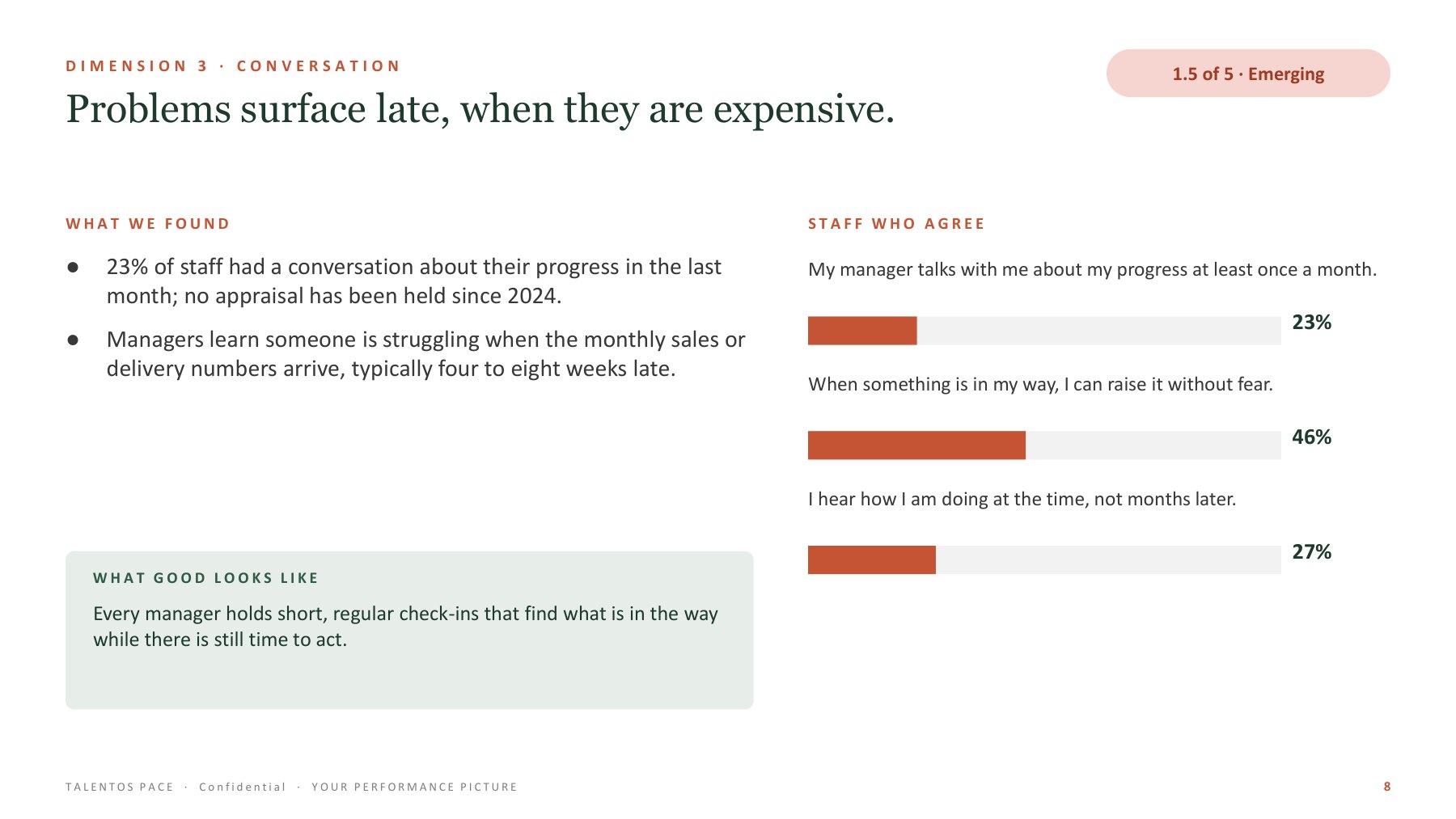
What one condition looks like in your report.
Each condition gets its own page: what we found, what your staff said, and what good looks like. The score is never a feeling. It traces back to interviews, anonymous responses and records.
The research behind the practices
- Goals need to fit the work.
- Clear objectives and feedback help people understand progress. Complex work may need learning goals and room to adapt, rather than rigid targets.
- Feedback needs care.
- Feedback can help or harm performance, depending on how it is given. PACE conversations focus on the work, the evidence and the next action.
- Assess practices through evidence.
- The World Management Survey uses open questions and defined scoring standards to examine management practices. These inform how Talentos gathers and assesses evidence.
CIPD: performance managementCIPD: performance feedback evidence reviewWorld Management Survey methodology
PACE brings these practices together in Talentos’s own method. The complete method has not been independently validated. We track changes using the same conditions and measures over time.
Keep a record you can explain.
PACE builds a record of expectations, progress, support and the employee’s response.
Kenya’s Employment Act requires a valid, fair reason and a fair procedure for termination. Section 41 provides for explaining the proposed reason in a language the employee understands, allowing a fellow employee or shop-floor union representative of their choice, and hearing and considering their representations.
Employment Act 2007, sections 41, 43 and 45
General information, not legal advice. A record supports a decision; it does not by itself make the decision lawful.
Know what to address first.
The Performance Picture brings together your view, your team’s experience and your records. In ten working days, see where performance management needs attention and what to do next.