Grace built a 30‑person business.Then it started to depend on her for everything.
Follow Nuru Distribution from its first Performance Picture to a six-month PACE Check. Every page shown here is a real Talentos deliverable, filled in for a fictional company.
The business is growing. So is Grace’s list.
Nuru Distribution has 30 people across Sales, Operations, and Finance and Admin. Grace, the founder, wants to grow annual revenue from KSh 150 million to KSh 190 million. She hired three managers to help her get there.
And yet, before nine o’clock, her phone has already decided her day.
- The targets live in her head, and in one revenue number.
- Her managers bring the decisions back to her, even the ones they could make.
- She hears about problems when a customer complains.
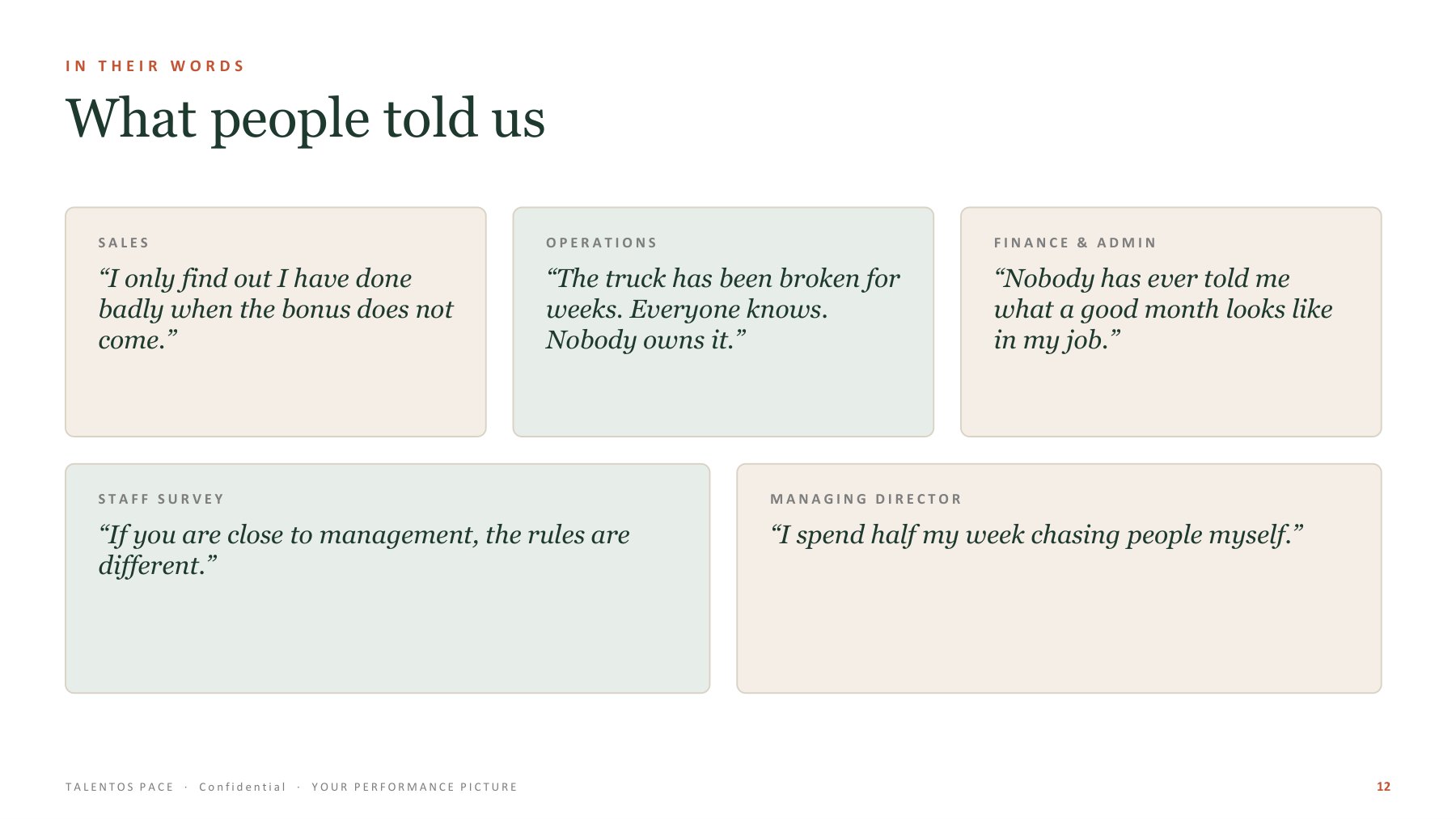
- A delivery truck has been broken for weeks. Everyone knows. Nobody owns it.
“I spend half my week chasing people myself.”
- 30
- people in three teams
- KSh 190m
- revenue target, up from KSh 150m
- ½
- of Grace’s week spent following up on work
If any of this sounds like your Monday, the rest of this page is what happens next.
Grace makes a guess.
The Performance Picture starts by agreeing the scope, the dates and how staff confidentiality will work. Then Talentos asks Grace to do something unusual: estimate how many of her staff would agree with sixteen plain statements about how performance works at Nuru.
“I know what the business is trying to achieve this year.” “My manager talks with me about my progress at least once a month.” “Judgements here are based on facts, not favouritism.”
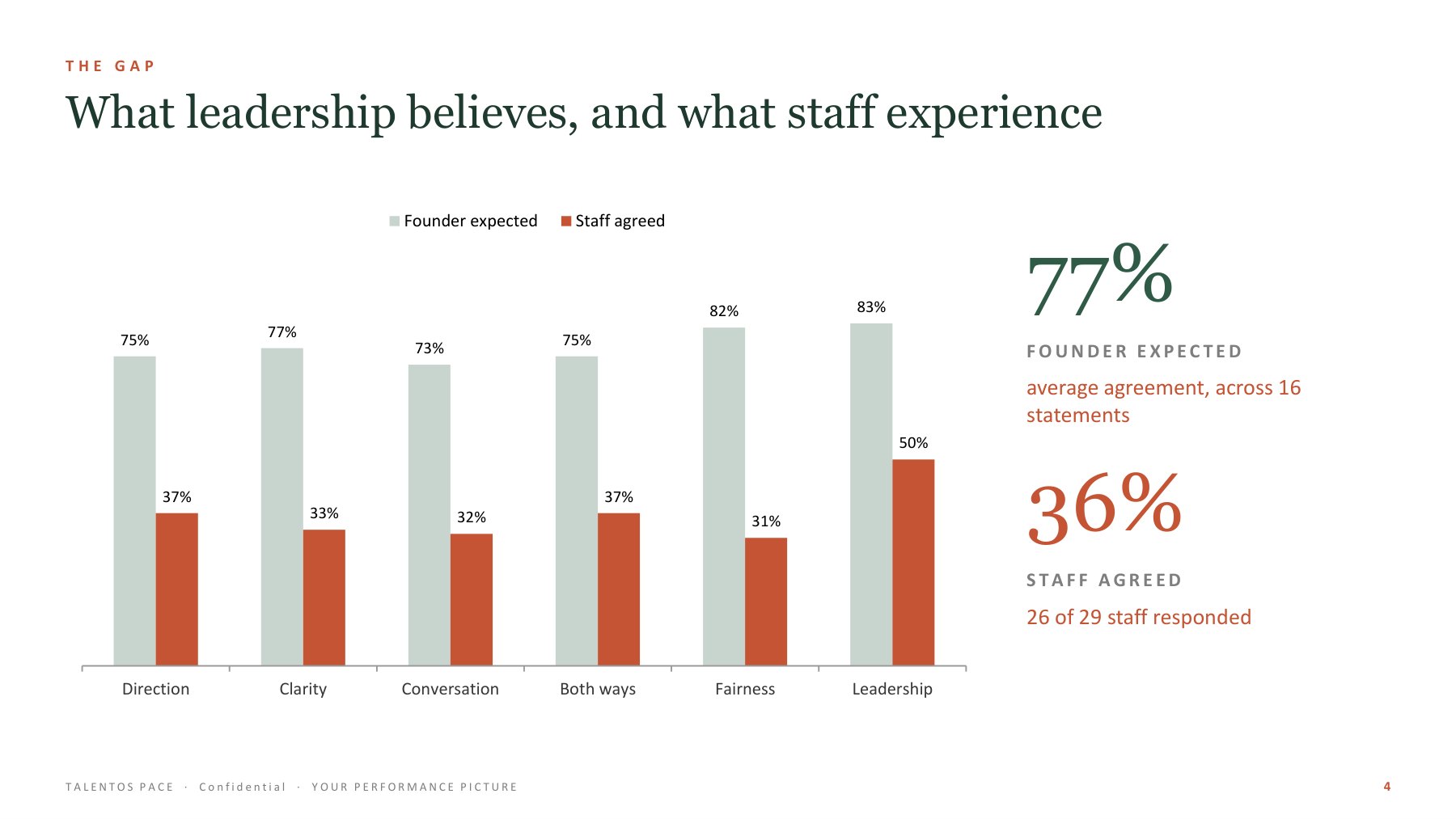
Her average guess is 77%. She writes it down. It will matter later.
Sixteen statements about how performance works at Nuru, averaged.
The Performance Picture: what is really going on.
Talentos interviews Grace for 90 minutes and each manager for 45 minutes. Of 29 staff invited, 26 answer an anonymous five-minute survey on their phones. Contracts, job descriptions and appraisal records are reviewed.
Two assessors score each of the six PACE conditions separately against written descriptions of each level, then agree. Grace receives the result in a private readout.
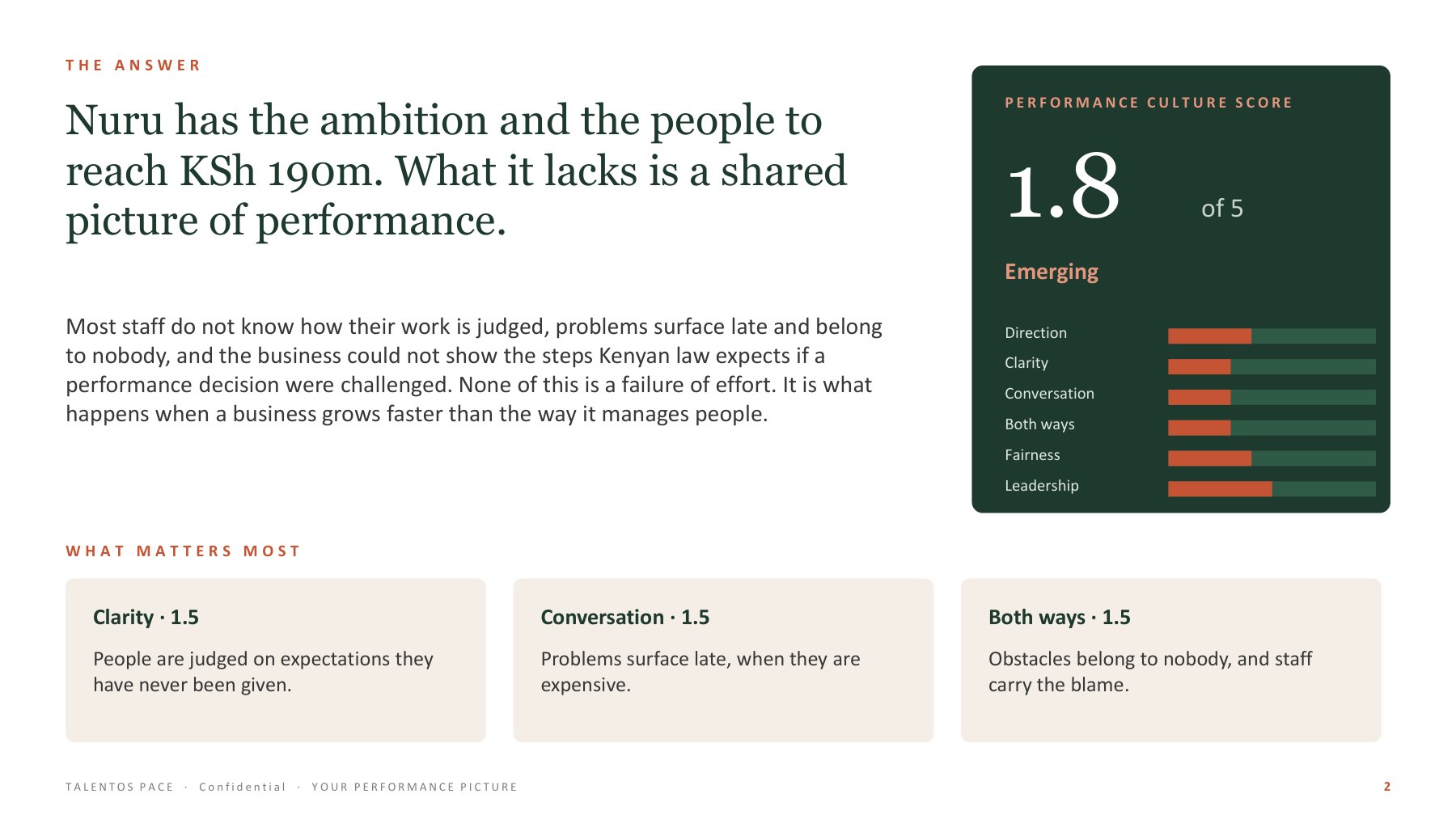
Nuru has the ambition and the people. What it lacks is a shared picture of performance.
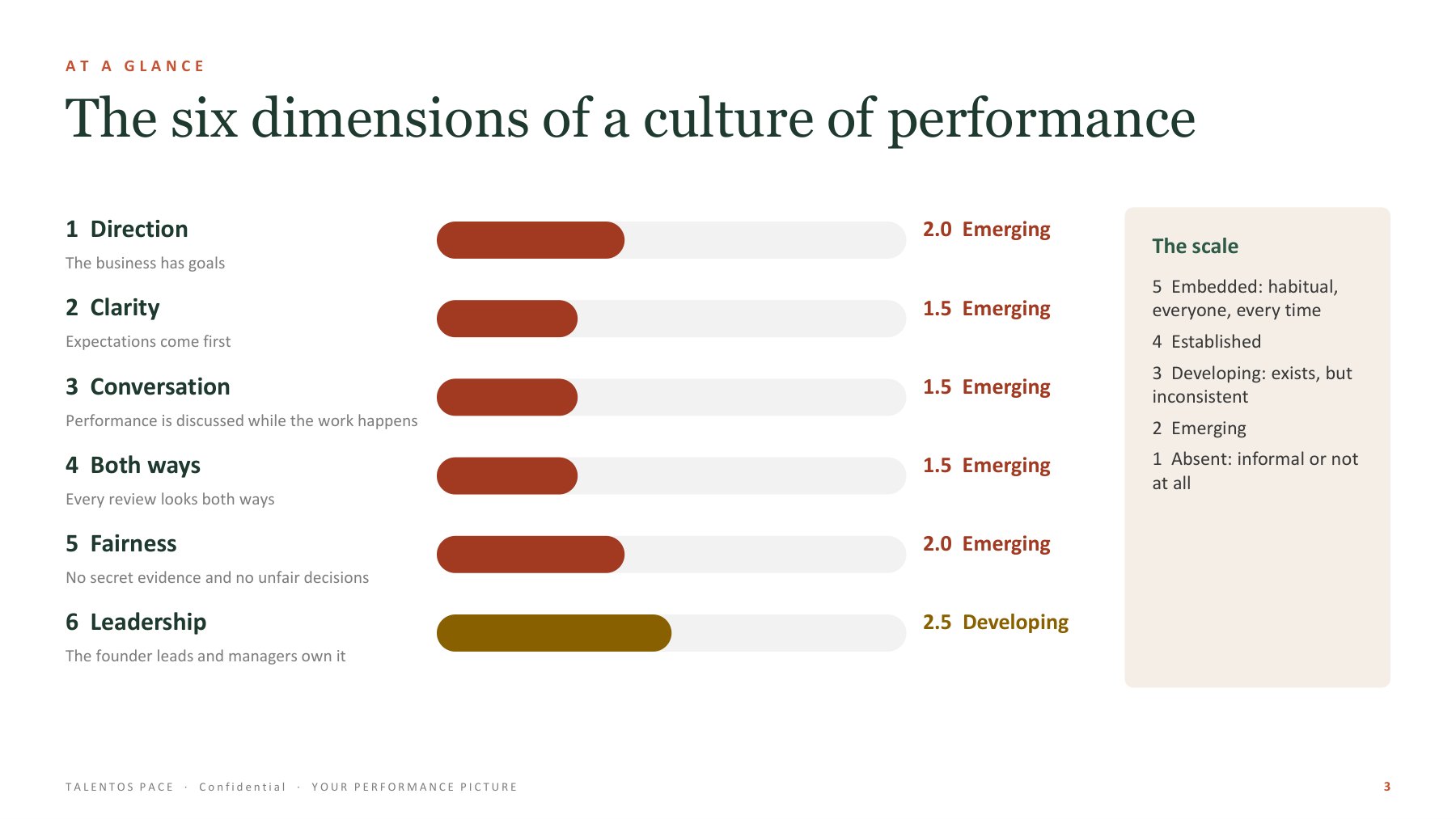
- Direction2.0
- Clarity1.5
- Conversation1.5
- Both ways1.5
- Fairness2.0
- Leadership2.5
She expected 77%. Her staff said 36%.
None of this is a failure of effort. Grace’s people are busy. They have simply never been told, in writing, what a good month looks like, or how their work will be judged. Problems surface late, and the obstacles in their way belong to nobody.
- My expectations were explained before I was judged on them.
- Personal relationships don’t change the standard.
- My manager discusses my progress at least monthly.
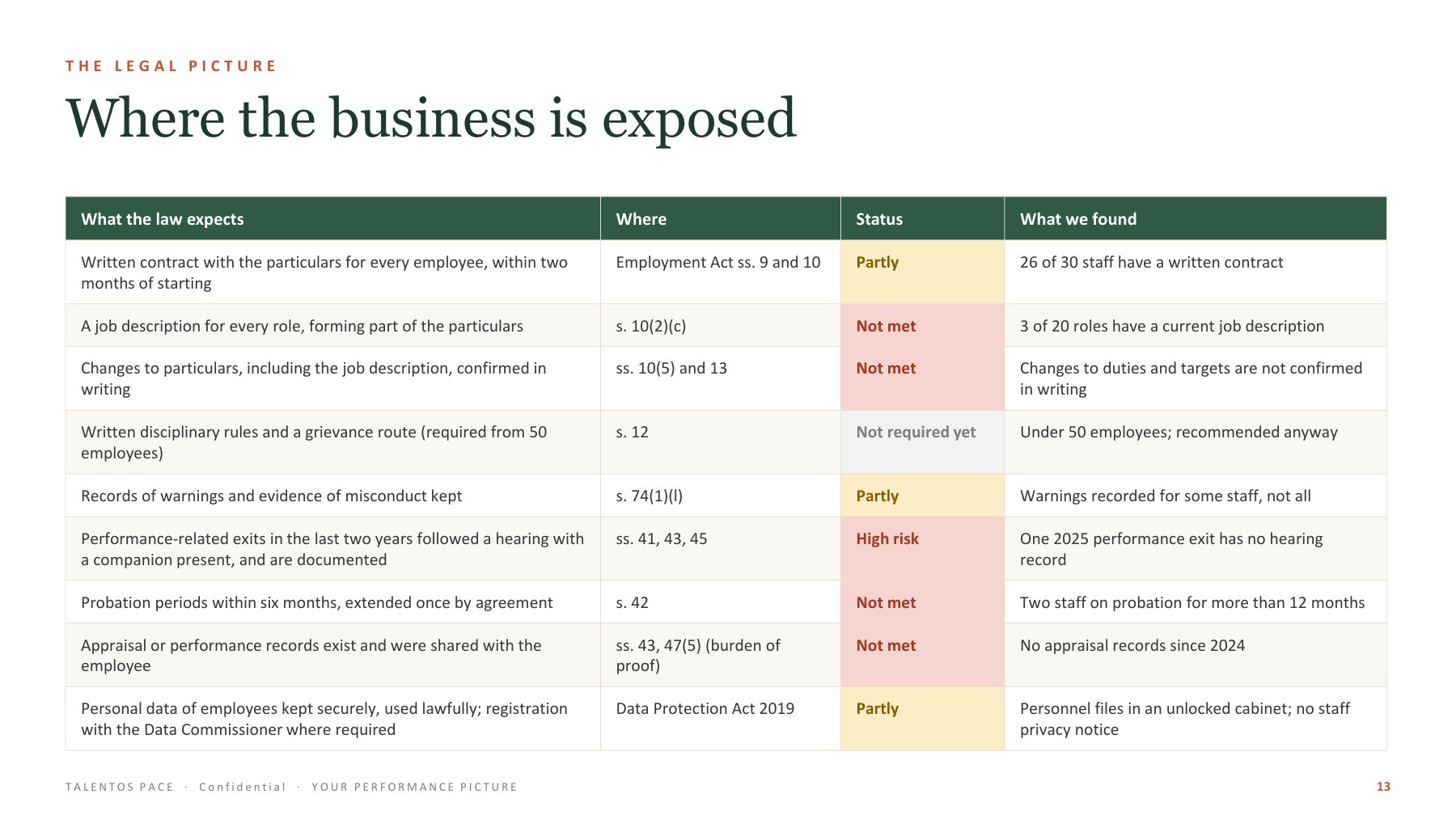
Where the business was exposed.
Only 3 of 20 roles have a current job description. There are no appraisal records since 2024. One performance-related exit has no record of a hearing, which could matter if it were ever challenged.
The Performance Picture sets out what the records show against what Kenya’s Employment Act expects, so Grace knows what to fix first.
General information, not legal advice.
Build: the business writes down what it expects.
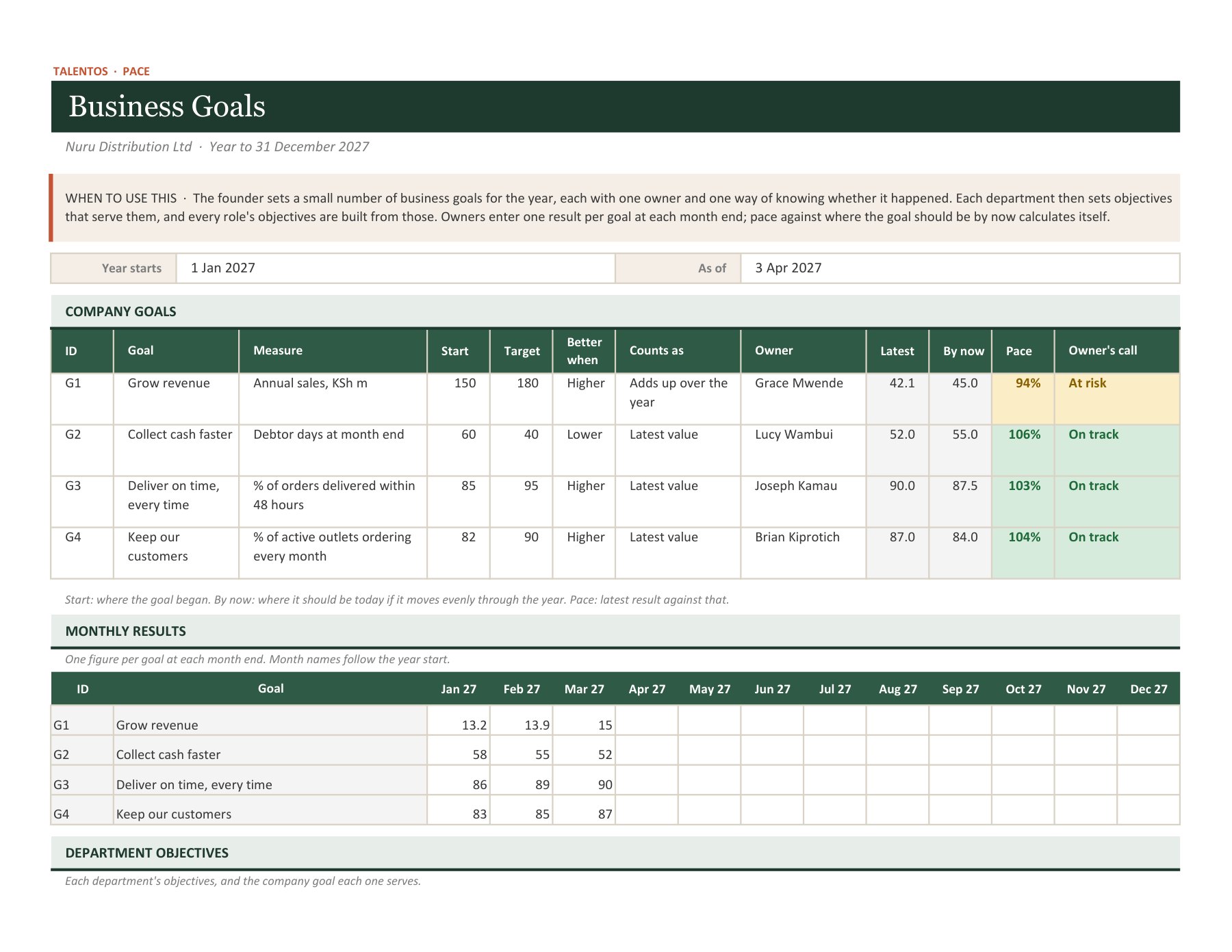
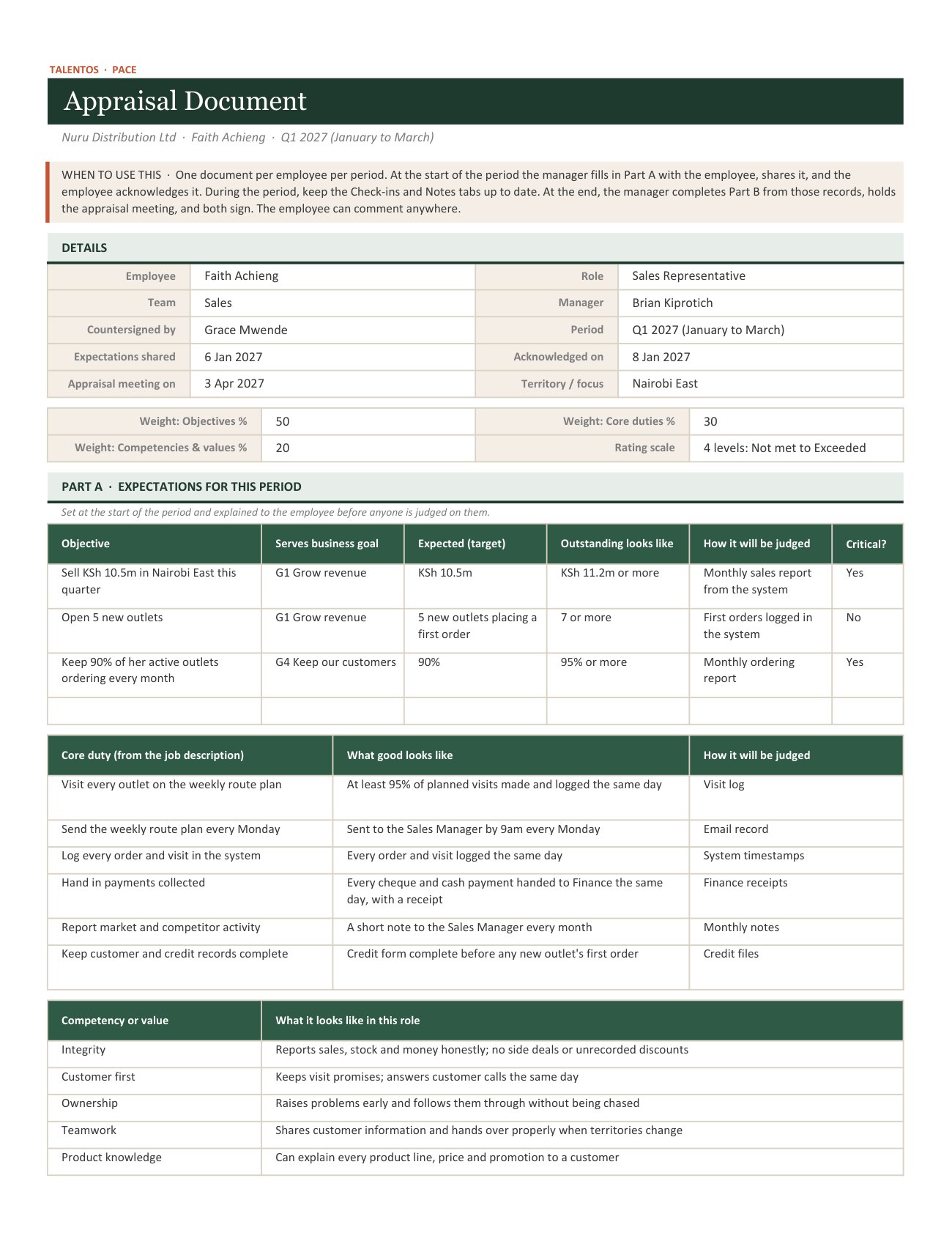
In a half-day session, Grace and her managers agree four business goals, each with an owner, a measure and a starting point. Then, role by role, every one of the 30 people gets written expectations built from those goals, explained and acknowledged before anyone is judged on them. Nuru’s performance policy and improvement-plan format are tailored, and a workspace is set up in Nuru’s own Google account.
Run it together: the managers start managing.
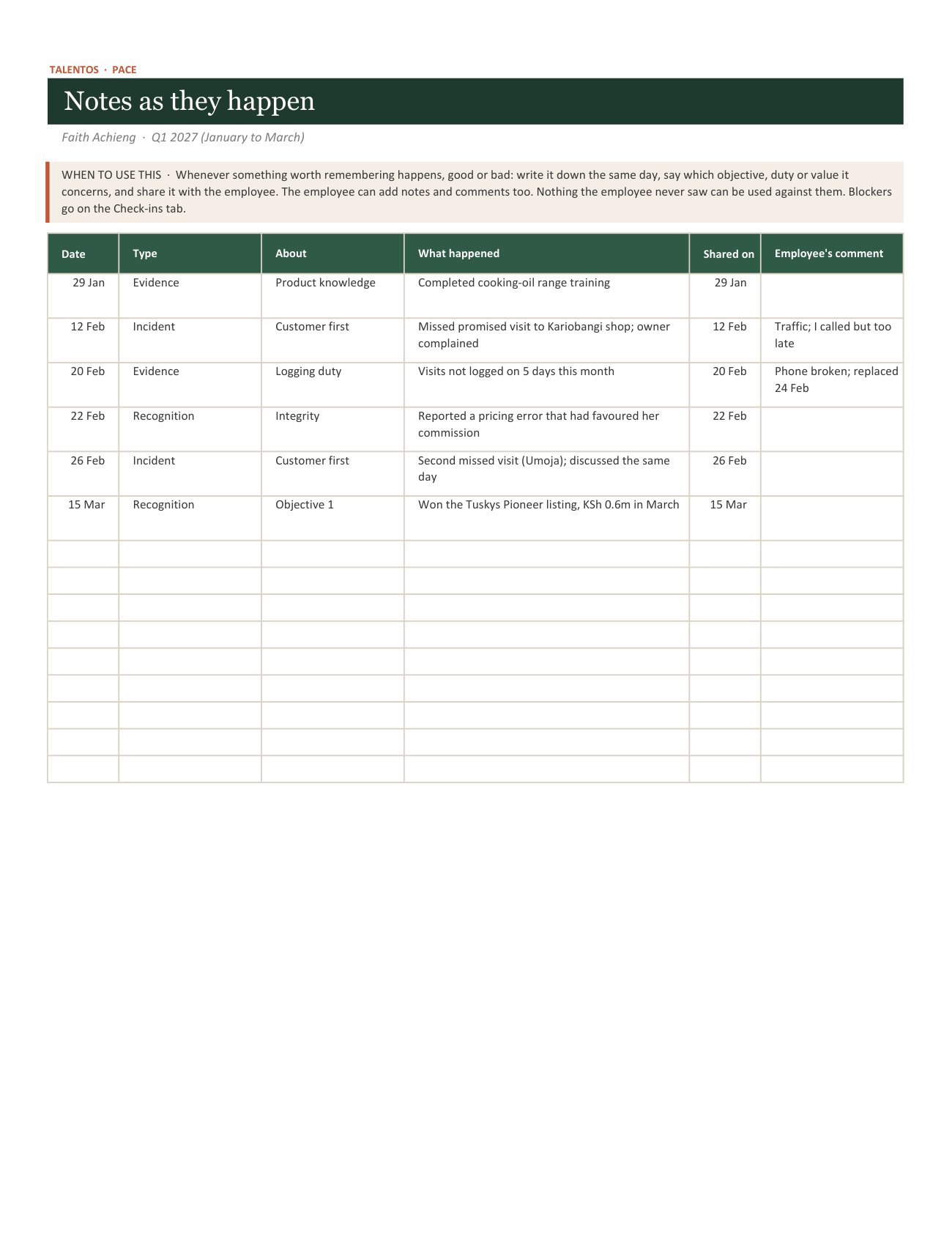
Five short training modules for Grace, her managers, staff and HR. Then Talentos sits in on each manager’s first expectation conversations and check-ins: what is on track, what is in the way, who does what next. Notes are written the same day and shared.
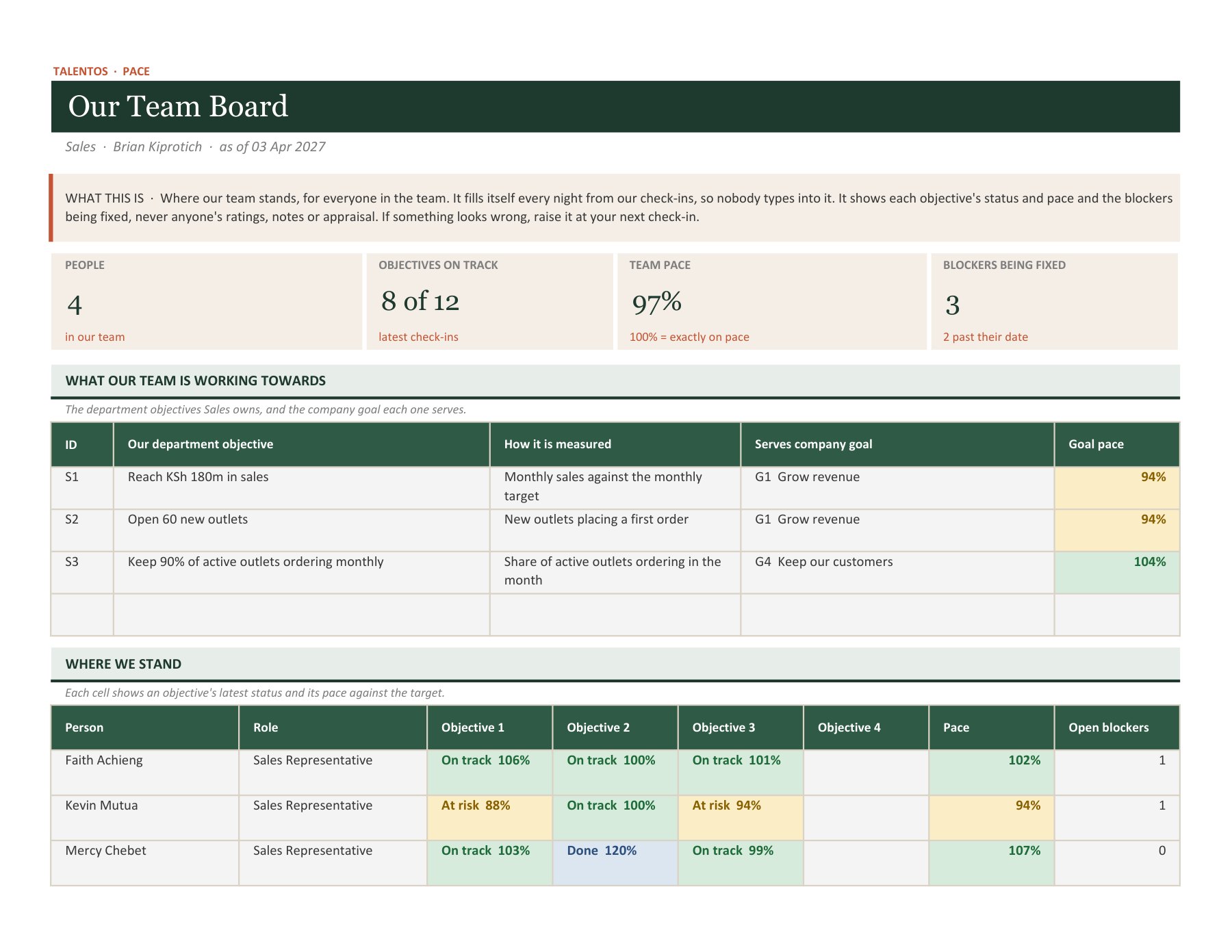
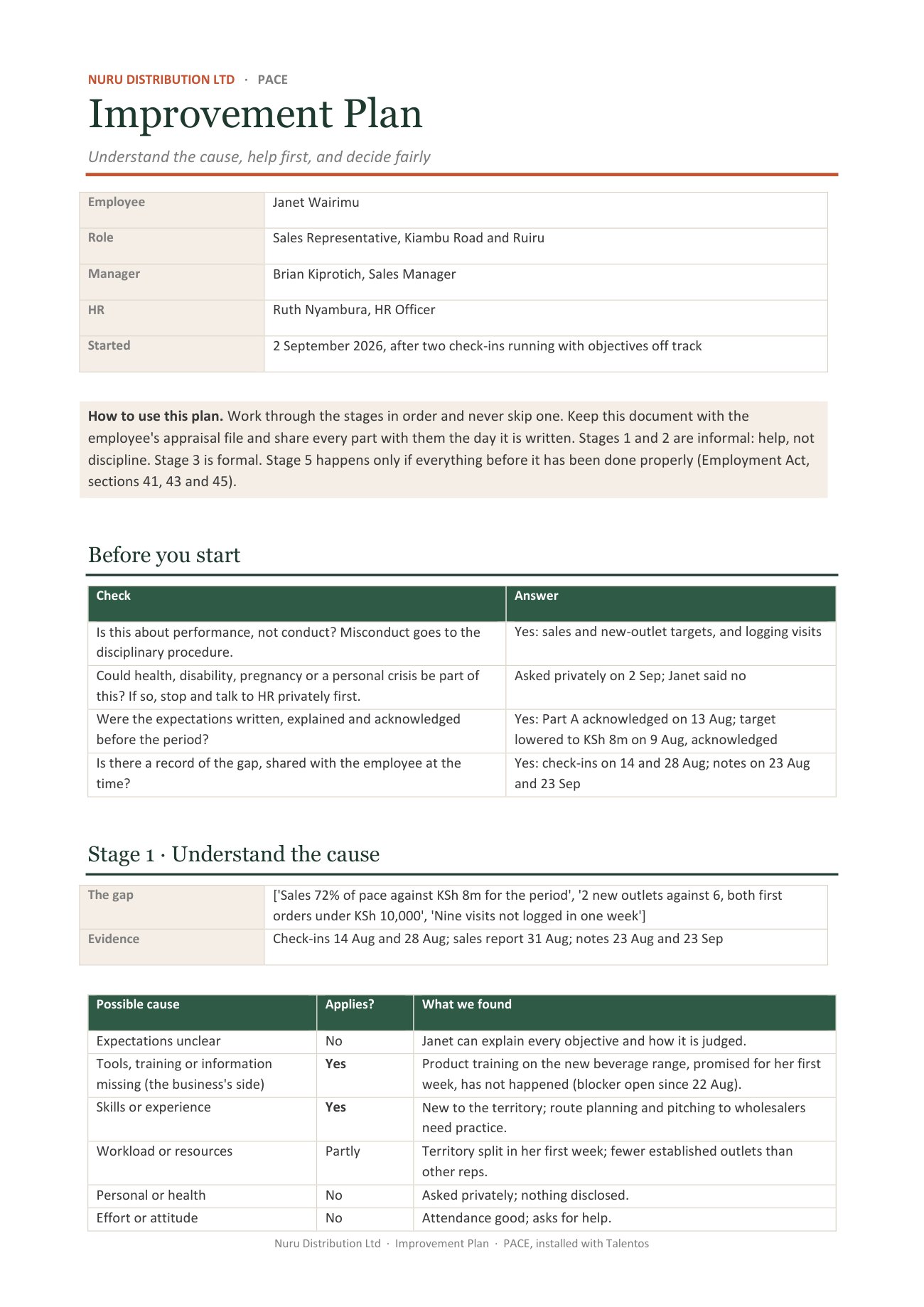
The Monday team meeting runs from the team board. Every blocker gets one owner and a date, including the broken truck. When someone does fall short, the improvement plan follows its stages in order, starting with understanding the cause.
The business keeps its side, and records it.
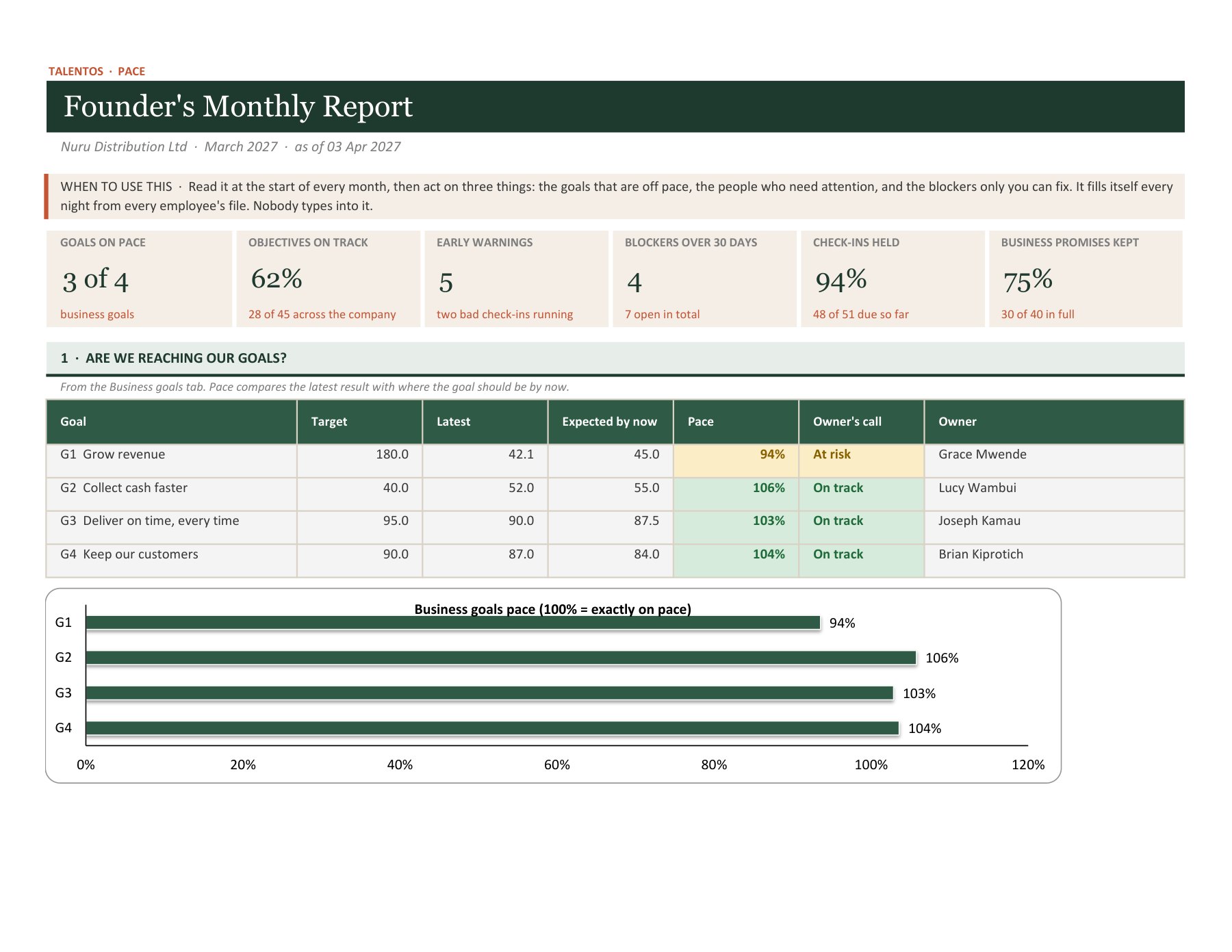
Grace opens one page.
It shows which teams are on track, what has been delivered, where work is falling behind and which decisions are waiting for her. She didn’t have to ring anyone to find out.
Her managers hold their check-ins without being chased. HR runs the quality checks. Talentos has stepped back to reviewing.
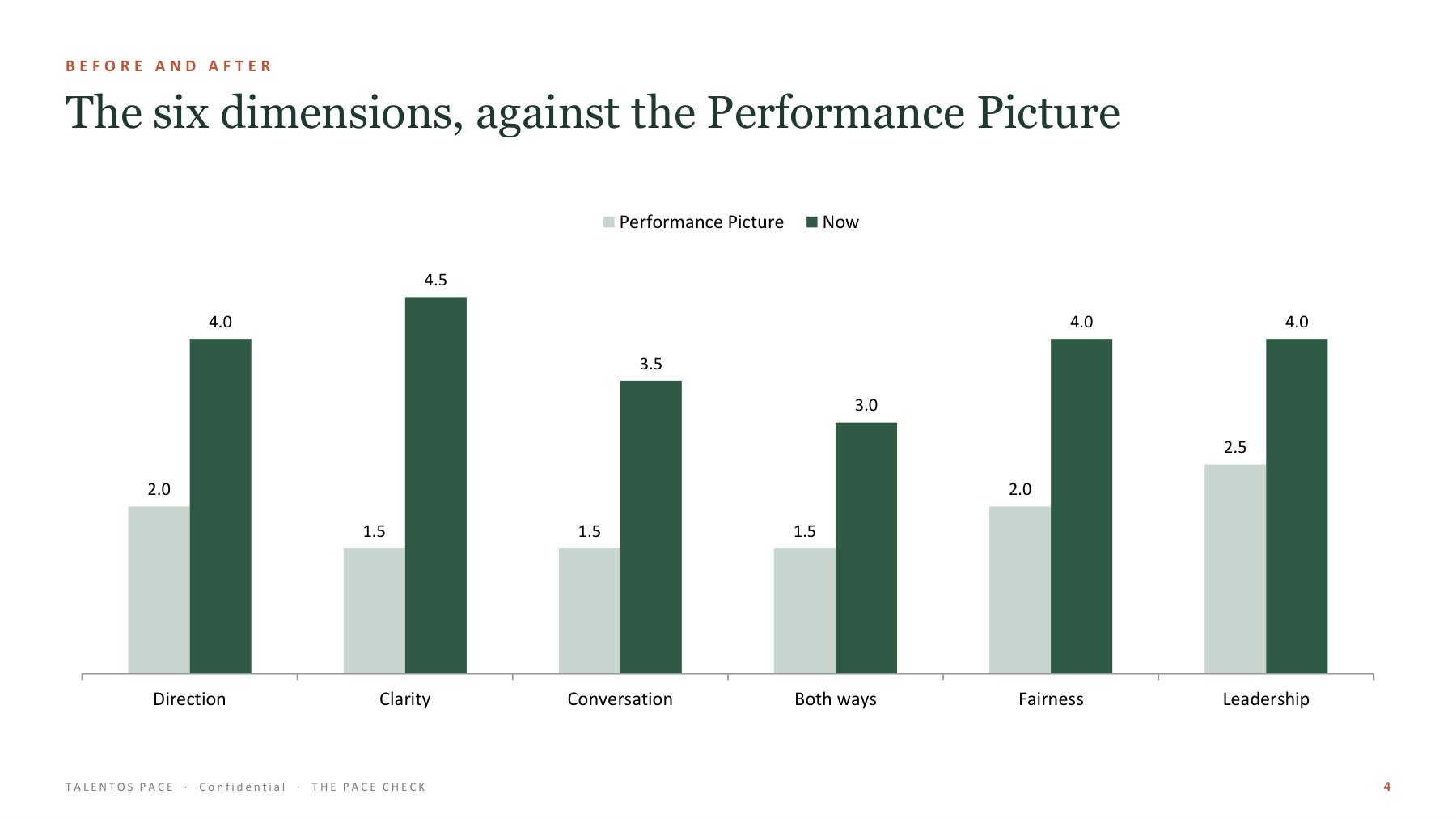
The PACE Check measures the same things again.
- Direction2.0 → 4.0
- Clarity1.5 → 4.5
- Conversation1.5 → 3.5
- Both ways1.5 → 3.0
- Fairness2.0 → 4.0
- Leadership2.5 → 4.0
| Baseline measure | Start | Six months |
|---|---|---|
| Staff with current written expectations | 17% | 100% |
| Staff who know how their work will be judged | 27% | 81% |
| Staff with a progress conversation last month | 23% | 88% |
| Staff who say problems get owned and fixed | 31% | 72% |
| Staff who trust judgements are based on facts | 35% | 68% |
| Founder’s questions answered with evidence | 0 of 3 | 3 of 3 |
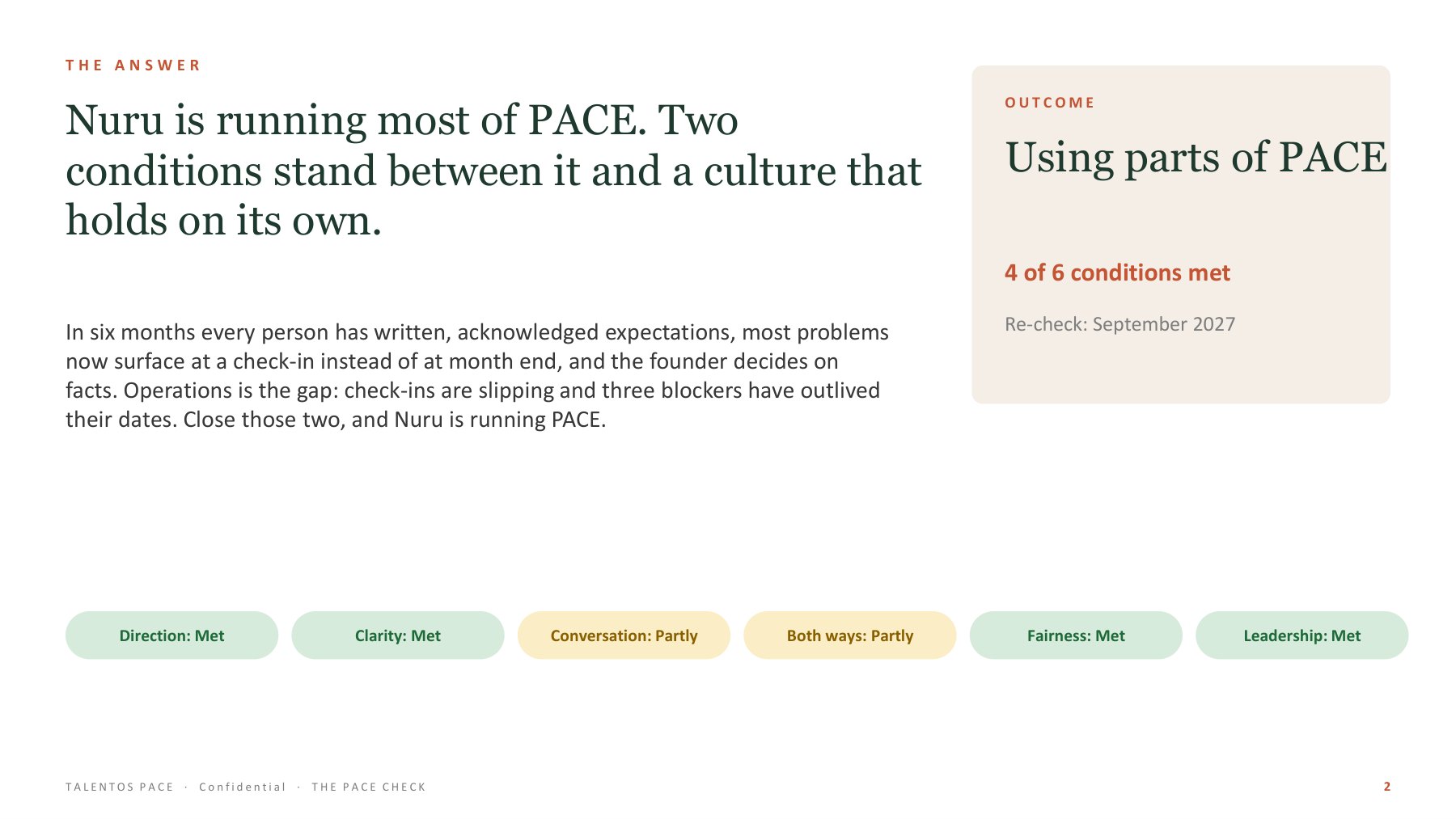
It isn’t finished.
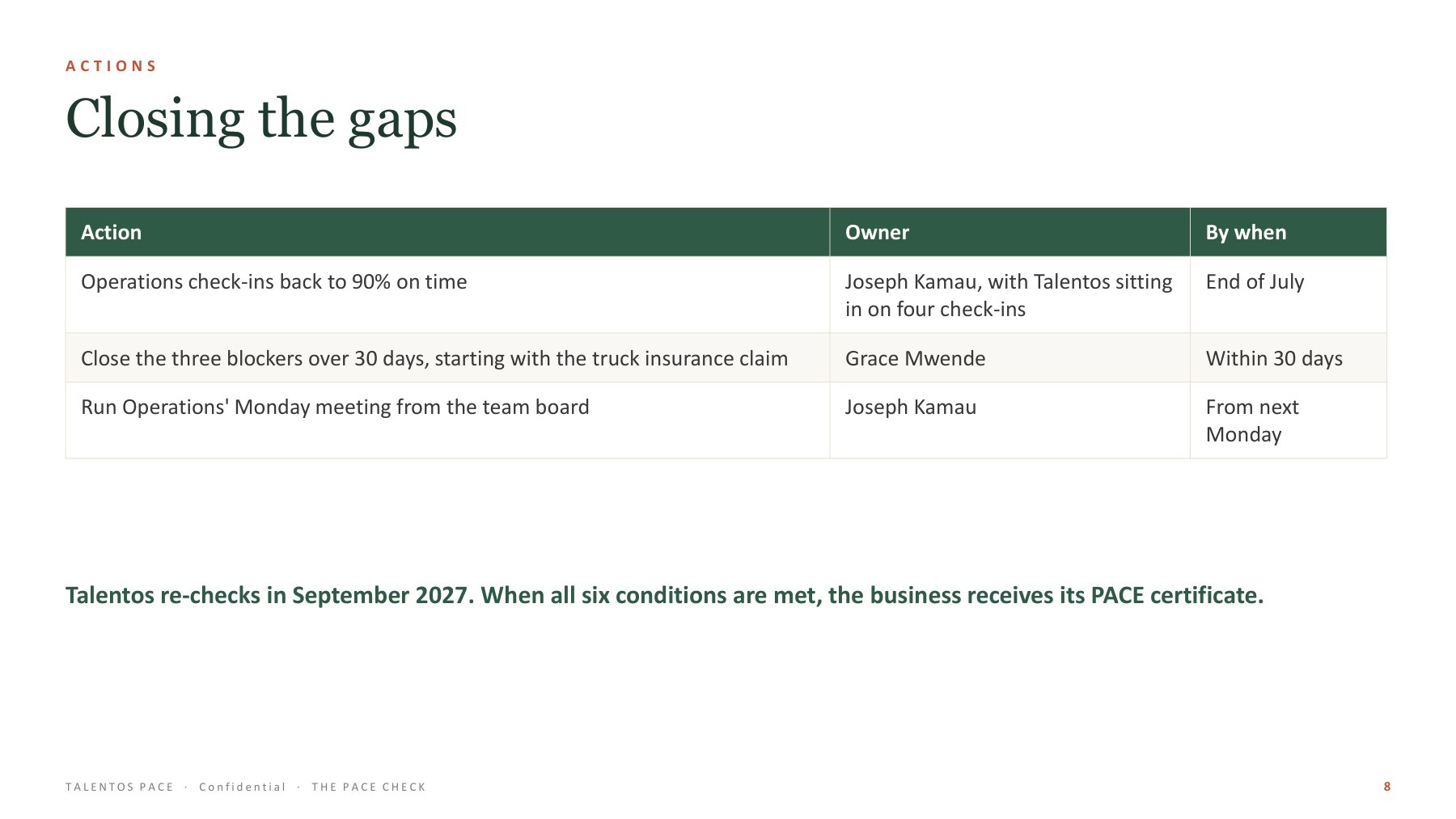
Operations check-ins are slipping and three obstacles are past their dates, including the truck insurance claim. The PACE Check sets three actions, each with a name and a date.
The difference now: everyone can see what is slipping, and someone owns it.
What you would get, in your own business.
- Your Performance Picture
- Your score, your staff’s view next to yours, your records and where you are exposed. The pages above, with your numbers.
- Written expectations
- For every role, built from your business goals and acknowledged before anyone is judged on them.
- Your workspace
- Team boards, check-in records and a one-page founder report, in your own Google account.
- Policy and process
- A performance policy and improvement-plan format written with Kenyan law in mind.
- Managers who run it
- Training, then coaching through real conversations until they run the routine without you.
- PACE Checks
- The same conditions and measures at 6, 12 and 24 months, so you can see what has held.
Illustrative worked example. Nuru Distribution is fictional. Its people, responses and figures were created to explain the method. They are not client results or predicted outcomes.