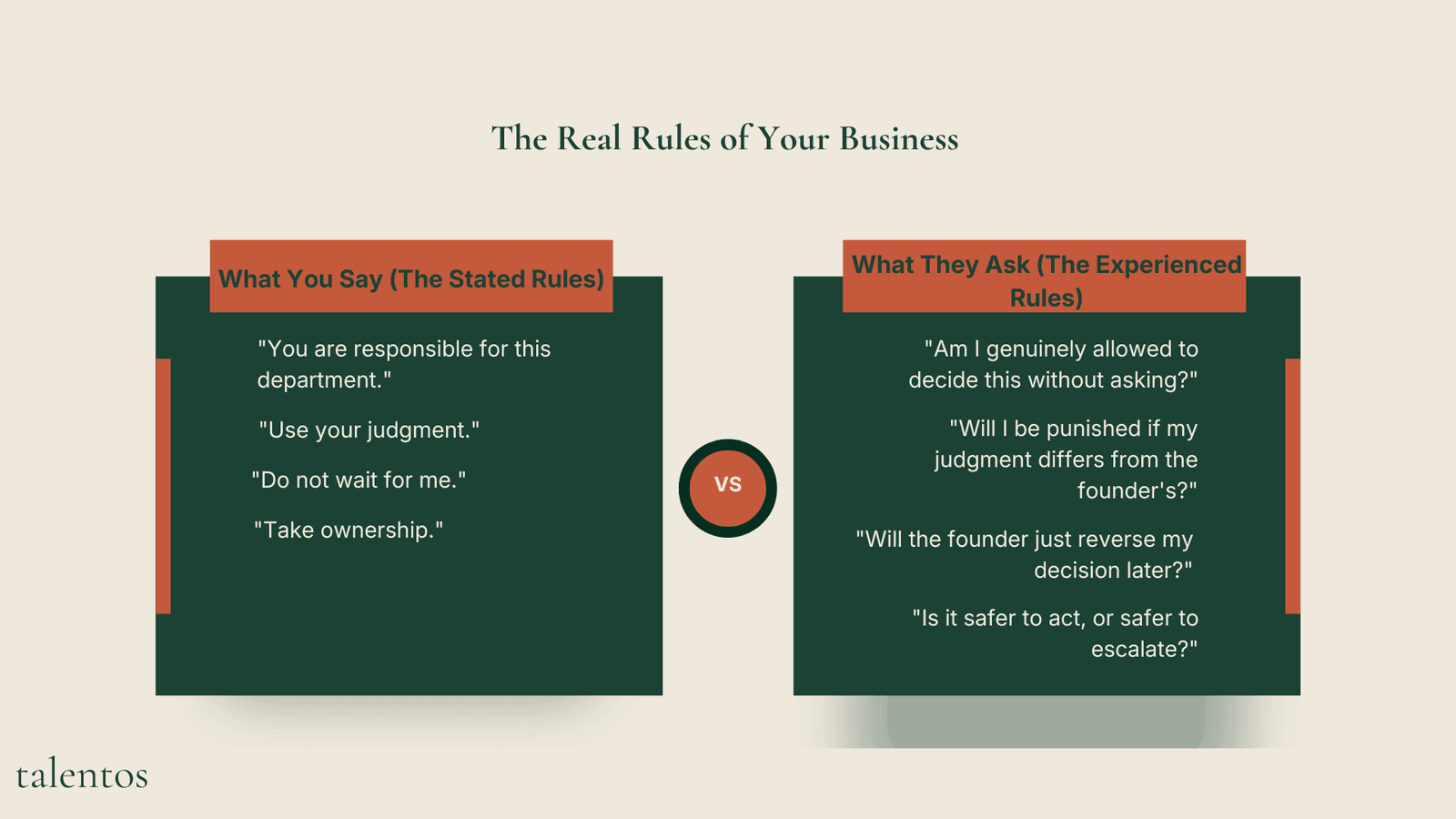
You've told your managers to take ownership. You may have said it in a management meeting, and again one-to-one. The questions still come. "Do you have a minute?" at the office door. WhatsApp messages at eight in the evening about a delivery, a refund or a staff member asking for leave.
Here's a typical one. A supplier delays a shipment. Your operations manager comes to you, explains the problem well, sets out the risks and what it means for the customer. Then she stops and waits for you to tell her what to do.
It's urgent, so you answer. You know the business, and giving the answer feels faster than walking her through your reasoning. The problem gets solved.
Something else happened in that conversation too. She learned that bringing the decision to you works. It's quicker for her, and if it goes wrong, it was your call. You see a manager who lacks initiative. She sees a business where the real decisions still belong to the founder. Each of you is drawing a reasonable conclusion from what you have seen.
What your managers learn from you
In most businesses there are the rules you say out loud and the rules people learn from experience. You say, "You're responsible for this department." What your manager has experienced is that if she makes a significant call without checking with you first, she gets questioned about it. You say, "Bring me solutions." What she's seen is that when her solution differs from yours, you replace it. So it's easier to ask first.
You may genuinely want managers who act on their own. But people follow the rules they've experienced. If you answer too quickly or take work back when it isn't perfect, you're teaching the opposite of what you're saying.
Three questions a manager asks before deciding
When a manager faces a decision, they're usually weighing three things, often without thinking about it.
Am I allowed to decide this? A title doesn't settle it. If your customer service head can't approve a KSh 5,000 credit note for an unhappy client without your signature, you've delegated the job of asking you for permission. You haven't delegated the decision.
Will my decision stand? Suppose your manager makes a reasonable call that isn't how you'd have done it, and you change it because you prefer your way. They learn that the job is to guess what you'd want. Asking you directly is more efficient than deciding twice.
What happens if it doesn't work out? A fair offer gets turned down. A promotion doesn't bring in the sales you hoped for. If every disappointing result ends with you taking the decision back, managers learn that the only safe decisions are the ones with guaranteed outcomes, and very few decisions come with that.
If the honest answer to any of the three is uncertain, waiting is the sensible choice from where they stand.
Everyday habits that teach waiting
Nobody builds this in one dramatic moment. It's built from small reactions, repeated over months. These come up often in the founder-led businesses we work with:
- Answering straight away. A manager brings a problem and you solve it on the spot. They've practised escalating, and you've become the fastest way to get an answer.
- Handing over the work but keeping the decision. A manager runs the project, but you still choose the supplier and approve every expense.
- Treating a different decision as a wrong one. You step in whenever their approach doesn't match yours.
- Finishing the work yourself. Their first draft is rough or they're slower than you, so you take it over. They learn that if they struggle long enough, you'll do it.
- Reacting more to mistakes than to delay. One manager makes a decision that goes badly and hears about it. Another sits on a decision for four days and nothing is said. The business learns that visible mistakes are dangerous and quiet delay is fine.
- Going around them. When a deadline is close you give instructions directly to their team. The team learns who really runs things, and so does the manager.
Asking for a decision is sometimes right
You don't want managers who never bring you anything. Some decisions should come to you, and a good manager knows which ones.
You can usually hear the difference. A manager who's escalating properly says something like, "This is above my spending limit. Here are the risks and here's what I recommend. Can I go ahead?" A manager who's learned to wait says, "I didn't want to get this wrong. What do you want me to do?" The first is responding to a risk that sits outside their authority. The second is protecting themselves.
How to change the pattern
A speech won't undo what months of reactions have taught. Your managers need a different experience of what happens when they decide. Start with these habits.
Give the decision back. When a manager brings you something that sits within their authority, don't answer it. Say, "This one's yours. Talk me through what you'd do." Then let them do it.
Ask about the reasoning. If their recommendation is weak, resist replacing it with yours. Ask what other options they looked at, what happens if they wait a week, and what they'd need to know to be more confident. You're using your experience to build their judgment.
Review the decision, and keep the authority where it is. When something goes wrong, look at how the decision was made. Did they have the right information? Did they think about the risks? If the reasoning was sound and the result was bad luck, say so. If the reasoning had gaps, talk about them. Pulling the authority back after one bad outcome teaches everyone to stop deciding.
Write the limits down. Most managers wait because they don't know where their authority ends. Take a distribution business in Nakuru with a sales manager, an operations manager and an accountant. (This is an illustrative example, not a client.) The founder writes a single page that says who can approve what: the sales manager can agree discounts up to 5% and credit of up to 30 days for existing customers; the operations manager can switch transporters and approve repairs up to KSh 50,000; anything above those limits comes to the founder with a recommendation. Once that page exists, a lot of questions stop arriving, because the manager knows the answer is already theirs.
Expect the first few weeks to feel slower. Some decisions will be made differently from how you'd make them, and a few will be worse. That's the cost of building managers who can run things when you're not there.
Telling them isn't enough
Many founders already know they should let managers decide. The difficulty is doing it consistently, every week, with every manager, when a customer is shouting and it would be quicker to just answer. In many growing businesses the founder hands decisions back when things are calm and takes them back the moment there's pressure. Managers notice which version of you shows up when it matters.
What makes the change stick is a way of managing that doesn't depend on the founder's mood or patience: written decision limits, regular check-ins where decisions get reviewed, and managers who are expected to follow through on what they own. That's the work Talentos does with founder-led businesses across Kenya.
The Performance Picture is a ten-working-day assessment of how performance is actually managed across your business. We hear from leadership and staff, look at the records, and show you where things break down, including where decisions get stuck on the way to you, and what to fix first. If you'd like a quicker read first, the free three-minute Quick Picture is a good place to start.
If your managers do decide but the work still lands on you at the points where their departments meet, read why hiring managers hasn't reduced your workload.